Table of Contents
- Why Homeowners Seek Alternatives to Home Equity Loans for Renovations
- Personal Loans for Home Improvement: Fixed Rates and Fast Funding
- Home Equity Lines of Credit (HELOCs): Flexible Borrowing for Phased Projects
- Cash-Out Refinancing: Consolidating Debt and Funding Renovations
- How to Budget for a Home Addition Without Overextending
- Home Equity Sharing and Reverse Mortgages: Non-Debt Alternatives
- Government-Backed and Credit Union Renovation Loans
- Tax Implications and Credit Score Impact of Different Financing Methods
- Frequently Asked Questions
Last Updated: October 1, 2026
Why Homeowners Seek Alternatives to Home Equity Loans for Renovations
Home equity loans have long been the default choice for financing major renovations, but home renovation financing alternatives offer distinct advantages for many homeowners.
Home equity loans put your primary residence at risk if you default, and they require lengthy approval, appraisals, and closing costs that can add thousands to your project. For homeowners who want to avoid tapping their equity or those with limited equity, home renovation financing alternatives offer real advantages.
The right financing method depends on your project scope, timeline, credit profile, and risk tolerance. This guide walks you through proven alternatives, each with distinct advantages for different situations.
Personal Loans for Home Improvement: Fixed Rates and Fast Funding
Personal loans are unsecured debt, your home isn’t collateral. For smaller to mid-sized renovations, this approach eliminates the complexity of home equity products.
How Personal Loans Work for Renovations
A personal loan gives you a lump sum upfront with fixed monthly payments over 3 to 7 years. Unlike a HELOC, where rates fluctuate, a personal loan locks in your cost from day one, making budgeting straightforward.
Personal loans typically carry higher rates than secured home equity products, but borrowers with strong credit (700+) can qualify for competitive rates that rival cash-out refinancing when closing costs are factored in.
Best Personal Loan Options
SoFi Personal Loans offer no origination fees or prepayment penalties, with funding within one business day. Loan amounts range from $5,000 to $100,000, though rates depend heavily on credit score.
Earnest Home Improvement Loans offer customizable payment schedules and fixed rates, requiring solid credit history for best rates.
LightStream Home Improvement Loans target excellent-credit borrowers with no fees and a Rate Beat program, up to $100,000.
Marcus by Goldman Sachs Personal Loans work well for mid-sized projects under $40,000 with fixed rates and no fees.
| Lender | Max Loan | Best For | Key Advantage |
|---|---|---|---|
| SoFi | $100,000 | Speed-focused borrowers | Same-day funding |
| Earnest | Varies | Flexible payment needs | Customizable schedule |
| LightStream | $100,000 | Excellent credit | Lowest rates available |
| Marcus | $40,000 | Mid-sized projects | Simple, transparent terms |
Personal loans make sense for projects between $5,000 and $40,000 with solid credit, fast closing, and no appraisals, or if you want to preserve home equity.
Home Equity Lines of Credit (HELOCs): Flexible Borrowing for Phased Projects
A HELOC works like a credit card backed by your home equity. You draw as needed and pay interest only on borrowed amounts, making it powerful for multi-stage renovations.
A HELOC lets you draw funds as needed across multiple phases, $20,000 in April, $15,000 in September, $10,000 in December, paying interest only on amounts drawn. After the draw period (5-10 years), you make fixed payments to pay down the balance.
The risk: variable interest rates tied to prime. A $50,000 HELOC at 7% costs roughly $290 monthly; at 9%, it costs $375 monthly. This uncertainty can strain budgets over time.
Navy Federal Credit Union HELOC offers competitive variable rates and low or no closing costs for members.
Professional Federal Credit Union HELOC serves local members with flexible draw structures and easy access to funds.
HELOCs work best for phased renovations with unpredictable spending. They’re less suitable if rising rates would strain your budget or if you prefer payment certainty.
Cash-Out Refinancing: Consolidating Debt and Funding Renovations
Cash-out refinancing replaces your existing mortgage with a larger one. If your home is worth $400,000 and you owe $250,000, you could refinance for $320,000, receiving $70,000 in cash for renovations.
If rates have dropped or your credit has improved, refinancing at a lower rate while pulling cash can lower your total monthly payment despite borrowing more.
Rocket Mortgage Cash-Out Refinance simplifies the process with online application and fast underwriting. Mortgage interest may be tax-deductible, unlike personal loan interest, consult a tax advisor.
Closing costs typically run 2-5% of the loan amount. On a $70,000 cash-out, expect $1,400 to $3,500 in costs. You’re also extending your mortgage term, increasing total interest paid even if the rate is lower.
Cash-out refinancing makes sense for large projects ($50,000+) when interest rates are favorable, your credit has improved since your original mortgage, and you plan to stay in your home long enough to recoup closing costs. For smaller projects or short time horizons, the closing costs often outweigh the benefits.
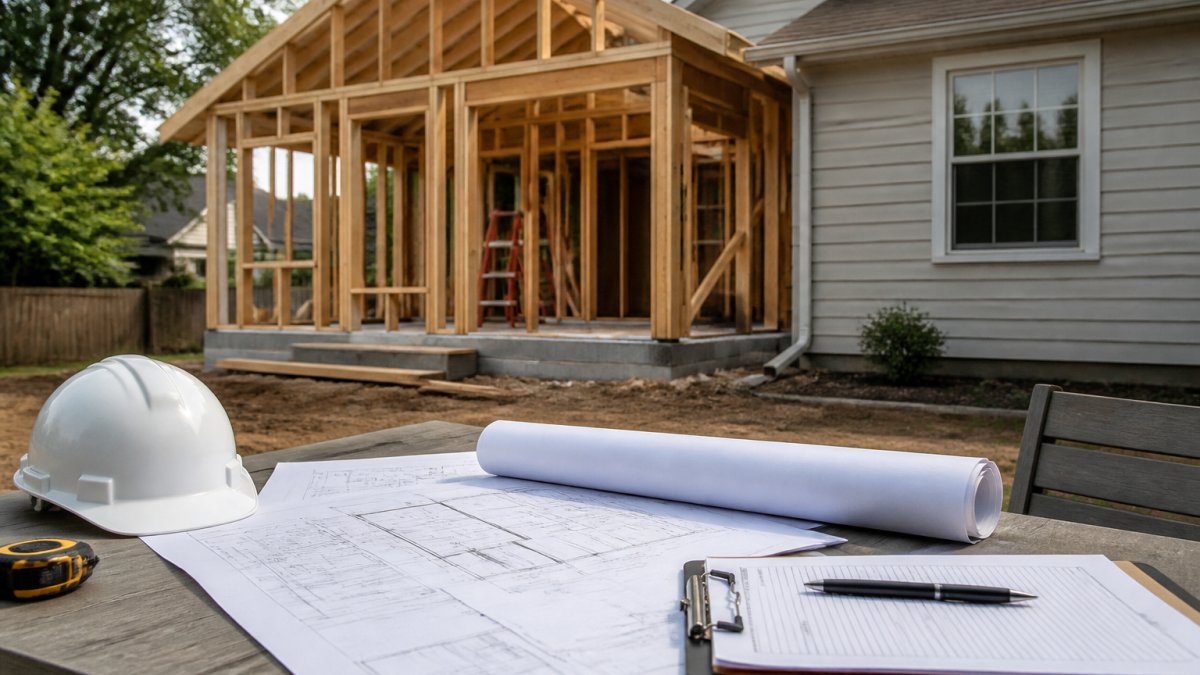
How to Budget for a Home Addition Without Overextending
The biggest mistake homeowners make is underestimating project costs. Renovations rarely come in on budget. Structural issues emerge during demolition. Material prices fluctuate. Labor takes longer than expected. A realistic budget accounts for these realities.

Setting a Realistic Renovation Budget
Start with a detailed scope of work. Know exactly what you’re changing: square footage, materials, finishes, systems (electrical, plumbing, HVAC). Get written estimates from at least three contractors. Don’t pick the lowest bid, pick the one that’s detailed and realistic.
Add a contingency reserve of 15-20% to your total estimate. If your project costs $100,000, set aside $15,000-$20,000 for surprises. This isn’t pessimism; it’s experience. Structural issues, code compliance upgrades, and design changes are normal. A contingency prevents these from derailing your project or forcing expensive financing decisions mid-construction.
Know your financing costs. A personal loan at 8% for $50,000 over five years costs roughly $1,150 monthly. A HELOC at 7% variable costs $290 monthly during the draw period, then increases during repayment. A cash-out refinance extends your mortgage but may lower your overall payment. Calculate the true cost, principal plus interest, not just the monthly payment.
Matching Financing to Project Scope
Small projects under $15,000 work well with personal loans or credit cards. The approval is fast, and you’re not putting your home at risk. Medium projects ($15,000-$50,000) fit personal loans or HELOCs. Large projects ($50,000+) may justify cash-out refinancing or a home equity loan, depending on your equity position and rate environment.
The timeline matters too. If you need funds immediately, a personal loan wins. If your project unfolds over 18 months with phased spending, a HELOC’s flexibility is valuable. If you’re consolidating existing debt and funding renovations together, cash-out refinancing might lower your total monthly obligations.
Before committing to any financing, run the numbers both ways: total interest paid over the full repayment period, not just monthly payment. A lower monthly payment sometimes means paying thousands more in interest overall.
Home Equity Sharing and Reverse Mortgages: Non-Debt Alternatives
Not all renovation financing involves debt. Two alternatives shift the model entirely: home equity sharing and reverse mortgages.
Home Equity Sharing (offered by companies like Hometap) works like this: an investor provides cash for your renovation. In exchange, they receive a percentage of your home’s appreciation when you sell or refinance. No monthly payments. No interest. No debt on your credit report. The catch: you’re giving up a slice of future home value.
If your home appreciates $100,000 and the investor owns 20% of that appreciation, they receive $20,000. If your home appreciates only $20,000, they receive $4,000.
Home equity sharing and reverse mortgages are complex products with lasting implications. Work with a financial advisor to ensure they align with your long-term goals and estate plans.
Government-Backed and Credit Union Renovation Loans
Government programs and credit unions offer alternatives that traditional banks don’t advertise heavily.
Tax Implications and Credit Score Impact of Different Financing Methods
Financing method affects both your taxes and credit profile, factors many homeowners overlook.
The best financing choice depends on project size, timeline, equity position, credit profile, and risk tolerance. A $20,000 kitchen remodel calls for different financing than a $150,000 addition. Evaluate options using total cost, not just monthly payment.
Frequently Asked Questions
What is the best loan for home improvements without using home equity?
Personal loans and cash-out refinancing are top alternatives. Personal loans work best for smaller projects ($5,000-$40,000) because they have fixed rates, no collateral requirement, and fast funding. For larger renovations, a cash-out refinance consolidates your mortgage and renovation costs into one payment, often at lower rates. The best choice depends on your project size, credit score, and how quickly you need funds.
How do personal loans for home improvement compare to HELOCs?
Personal loans offer fixed interest rates and predictable monthly payments, making budgeting easier. HELOCs have variable rates that can increase over time, but you only pay interest on what you actually borrow. Personal loans suit homeowners who want payment certainty; HELOCs work better for multi-phase projects where you draw funds as needed. HELOCs typically offer lower rates if your credit is strong, but rates can climb if market conditions shift.
Should I use a credit card or personal loan for home renovations?
Personal loans are generally better for renovations over $5,000. Credit cards carry higher interest rates (often 15-25% APR) and can damage your credit score if you carry a large balance. Personal loans have fixed rates, longer repayment terms, and won’t spike your debt-to-income ratio as severely. Reserve credit cards for smaller, urgent repairs or projects under $3,000 that you can pay off quickly.
What tax benefits do home equity loans and refinancing offer?
Mortgage interest (including cash-out refinance interest) may be tax-deductible if you itemize deductions and the loan is secured by your home. Personal loans and HELOCs are not tax-deductible. However, renovations that add significant value or improve your home’s condition can increase your home’s basis, potentially reducing capital gains taxes when you sell. Consult a tax advisor about your specific situation, as deductibility depends on loan type and how you use the funds.
How does each financing option affect my credit score?
All financing options trigger a hard inquiry (small temporary dip) and add new debt to your credit report. Personal loans and HELOCs are installment accounts; credit cards are revolving. High credit card balances hurt your score more than installment loans. Cash-out refinancing replaces existing debt rather than adding new debt, so it may have less impact. Secured loans (HELOCs, home equity loans) use your home as collateral, while personal loans don’t, making them riskier for lenders but not your credit.