Table of Contents
- Why the Custom Home Construction Contract Decides Your Project
- New Home Construction Contract Checklist: The Core Documents
- Price, Itemized Budget, and Allowances in a Custom Home Construction Contract
- Construction Contract Payment Schedule: Deposits, Draws, and Lien Waivers
- The Construction Change Order Process and Written Approval
- Construction Contract Completion Date, Delays, and Force Majeure
- Inspections, Punch List, and Final Acceptance
- Conclusion
- Frequently Asked Questions
Last Updated: October 21, 2026
Why the Custom Home Construction Contract Decides Your Project
A custom home construction contract sets the price, schedule, scope, and legal rights for your build. Most homeowners spend months choosing a builder and minutes reading the paperwork, that ratio is backwards.
Good projects can go sideways because a contract left one term vague. The document, not the handshake, decides what happens when a material is discontinued or rain pushes the schedule.
Below, we break down what to look for in a custom home construction contract, section by section, core documents, money terms, change orders, and the completion and acceptance rules that protect you.
New Home Construction Contract Checklist: The Core Documents
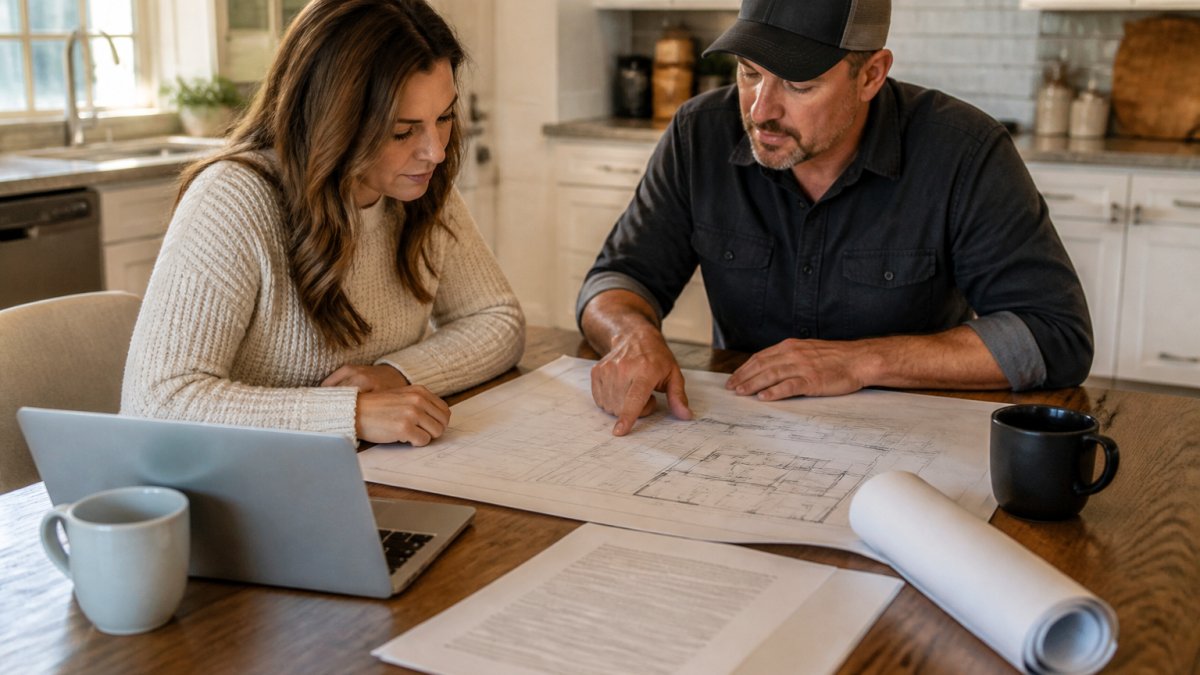
Every custom home construction contract should include six core pieces: contractor identity and licensing, proof of insurance, a detailed scope of work, plans and specifications, an itemized budget, and a payment schedule.
Think of this as your new home construction contract checklist. Print it, and check each item off as you review the draft.
Contractor identity, license, and insurance
The contract should name the exact legal entity doing the work, not just a trade name, full legal name, address, phone, and email, and list a current contractor license number.
Ask for a certificate of insurance showing general liability and workers’ compensation coverage. Call the insurer to confirm the policy is active. This one step catches more problems than any other.
Scope of work, plans, and specifications
The scope of work is the heart of the deal: what gets built, in what materials, to what standard. Attach plans, blueprints, and drawings as contract documents, plus written specifications for finishes and fixtures.
A common mistake is signing with a scope that says “builder-grade finishes” and nothing more. That phrase means whatever the builder decides it means. Insist on named products or an allowance with a stated dollar figure.
Price, Itemized Budget, and Allowances in a Custom Home Construction Contract
The contract price should be a real number backed by an itemized budget, not a lump sum on one line. Ask for a breakdown covering materials, labor, permits, subcontractors, and overhead, your only defense against a surprise overrun.
A useful test: can you point to the line item for every major system in the house, foundation, framing, roofing, HVAC, electrical, plumbing, cabinetry, and finishes?
Allowances: the line items that move the final price
An allowance is a placeholder budget for something not yet chosen, tile, lighting, plumbing fixtures, cabinetry, appliances, flooring, countertops, hardware. It is not the price you will pay; it is the builder’s estimate, and the gap between it and your actual selection is settled by change order.
That mechanism is where custom-home budgets drift: a $6,000 cabinetry allowance against selections that run well above it arrives as a signed change order mid-build. The fix is documentation, not optimism:
- Name the allowance items and their dollar figures in the contract, not in a side letter.
- Set a selection deadline for each allowance category, cabinetry, lighting, flooring, plumbing, appliances, tied to the construction schedule. Late selections delay the build and often trigger change orders.
- Define the overage procedure in writing: who prepares the change order, how the price is calculated, and that no upgraded product is ordered until you sign.
Watch for allowances set far below real market prices. A suspiciously low tile or lighting allowance is a common way to make a bid look cheaper than the competition. The gap reappears as an extra bill later. Compare each allowance against what comparable products actually cost before you sign.
Cost-plus versus fixed-price agreements
Cost-plus means you pay actual costs plus a set fee or percentage; fixed-price means the builder commits to a total and absorbs overruns. The contract should say plainly which one you are signing.
Fixed-price (also called stipulated sum). The builder commits to a total for the defined scope.
Cost-plus. You reimburse actual costs plus a fee. This is more transparent and easier to audit, but you carry the overrun exposure. Read three things closely:
- How the fee is calculated. A percentage fee on cost rewards higher spending. A flat fee or a capped percentage removes that incentive.
- What counts as a cost. Confirm whether the builder’s overhead, supervision, insurance, and warranty reserve are inside the fee or billed separately.
- Audit rights. A fair cost-plus contract gives you the right to review invoices, subcontractor bids, and supplier receipts. If the contract is silent on audit rights, ask for them in writing.
A common pattern is a hybrid: fixed price for shell and core, cost-plus or allowances for finishes.
Contingency and what it is for
Most custom-home contracts carry a contingency line, a reserve for unforeseen conditions. Ask what it covers, who controls it, and how unused funds are handled at closeout. A contingency the builder can spend without your approval is a slush fund, not a reserve; require written approval before dollars are drawn. Clear protocols for these project reserves often parallel the financial safeguards required when managing a home sale contingency during the transition between properties.
Construction Contract Payment Schedule: Deposits, Draws, and Lien Waivers
A construction contract payment schedule should tie each payment to completed work, not calendar dates: a modest deposit, then draws released at milestones like foundation, framing, and rough-in. Never pay the full contract price up front.
Every draw should come with a lien waiver from the builder and its subcontractors. A lien waiver confirms those parties have been paid for their work and gives up the right to file a lien against your property.
Hold back a retention percentage until final acceptance. This small cushion gives the builder a reason to finish the punch list promptly instead of moving to the next job.
The Construction Change Order Process and Written Approval
The construction change order process authorizes any adjustment to scope, price, or schedule.
Read the change order clause for two things: who can request a change, and how the price is set.
Ask what happens to the schedule when a change order lands. A good contract ties the completion date adjustment to the change order itself, so delays stay documented.
Construction Contract Completion Date, Delays, and Force Majeure
The construction contract completion date should be a specific calendar date with a defined extension process; “substantial completion in a reasonable time” gives you nothing to enforce. A single end date is not enough on a custom build, also set milestone dates (foundation, framing, dry-in, rough-in inspections, cabinets) so you can tell early whether the schedule is slipping.
Milestone dates and schedule mechanics
Ask for a schedule exhibit listing each milestone and its due date, and tie payment draws to those milestones rather than calendar dates. That aligns the builder’s cash flow with actual progress and documents any slippage.
Read how the contract handles schedule adjustments. A fair clause ties any extension to a written change order or a documented delay notice, so the completion date moves only when there is a reason on paper.
What counts as an excusable delay
Look for a delays clause that lists what counts as an excusable delay, events outside the builder’s control that justify moving the completion date. Typical categories include:
- Severe weather that prevents work
- Material or supply shortages beyond the builder’s control
- Permit or inspection backlogs caused by the permitting authority
The clause should also state what does not count: the builder’s own scheduling failures, subcontractor no-shows, cash-flow problems, or ordinary weather the builder should have planned for. A force majeure clause that swallows every delay is not a protection; it is an escape hatch.
Notice requirements and how extensions are granted
This is the part homeowners skip. Most delay clauses require the builder to give written notice within a set number of days after the delay begins, describe the cause, and state the schedule impact.
Read the clause for three things:
- The notice window. How many days does the builder have to notify you in writing?
- The supporting documentation. Does the notice have to include evidence, weather records, supplier notices, permit records?
- Your approval. Does the extension take effect automatically, or does it require your written sign-off?
A contract that grants extensions automatically on the builder’s say-so gives you no leverage. Ask for approval rights or, at minimum, a documented notice you can review.
Remedies for missed deadlines
Many contracts include a liquidated damages clause setting a per-day credit if the builder runs late without a valid excuse. Confirm the amount, how it is calculated, and whether it credits the final payment or is paid separately.
If the contract has no liquidated damages clause, ask what remedy you have for an unexcused delay. At minimum, the contract should give you the right to withhold final payment until the work is complete and to recover documented costs caused by the delay, such as extended rent or storage.
Calendar the notice deadlines and milestone dates as soon as you sign. A delay notice you did not respond to within the contract window can be treated as accepted.
Owner-caused delays
The delays clause cuts both ways. Miss a selection deadline, delay a walkthrough, or fail to provide site access, and the builder may be entitled to an extension and a change order for standby costs. Read the owner-responsibilities section alongside the delays clause.
Inspections, Punch List, and Final Acceptance
Final acceptance should follow a defined inspection and punch list process, not a walkthrough and a handshake. The contract should spell out who inspects, what quality standards apply, and how defects get fixed.
Here is how we would structure the closeout:
- Schedule a pre-final walkthrough with the builder and a third-party inspector
- List every incomplete or defective item on a written punch list with photos
- Set a firm deadline for punch list completion in the contract
- Confirm all required municipal inspections have passed and permits are closed
The punch list and retention holdback are your last real use. Do not release the final payment until every item is fixed and every lien waiver is in hand.
Conclusion
A custom home construction contract rewards the homeowner who reads closely and pushes back on vague terms. The work is unglamorous: checking licenses, questioning allowances, insisting on written change orders.
Remodeling Pros has guided homeowners through structural remodeling and additions since 1998, using sophisticated 3D design so you can see the project before we build it.
Get a quote from Remodeling Pros and start your build with a contract you actually understand.
Frequently Asked Questions
What should be included in a new home construction contract?
A complete custom home construction contract names the builder and their license and insurance details, describes the scope of work with plans and specifications, and sets an itemized budget and contract price. It should also spell out the payment schedule, allowances, the change order process, a start and completion date, permit and inspection responsibilities, warranty terms, and how disputes get resolved. Missing any one of these leaves you exposed to cost overruns and schedule surprises.
What payment schedule is reasonable for a custom home build?
A reasonable construction contract payment schedule ties each draw to completed work, such as foundation, framing, and rough-in stages, rather than to calendar dates. Large upfront deposits leave you little leverage if the builder stalls. Ask for lien waivers with each payment so subcontractors confirm they were paid. Any schedule that front-loads most of the money before meaningful work is done deserves a hard second look before you sign.
How should a contract handle change orders and delays?
The construction change order process should require written approval before any extra work begins, with the cost and schedule impact stated in the document. For delays, the contract should define the construction contract completion date, list excusable events like weather or permit holds, and state what happens if the builder misses the date. Clear terms on both points prevent the disputes that stall projects.
Should I have a lawyer review a custom home construction contract before signing?
Yes. A construction attorney can catch one-sided terms, vague scope language, and missing protections that are easy to overlook. Bring the full contract documents, including plans, specifications, and the payment schedule, to the review. Ask specifically about termination clauses, warranty language, and dispute resolution. The cost of a review is small compared to the cost of a contract that leaves you responsible for overruns or delays you did not cause.