Table of Contents
- What an Incredible Kitchens Alternative Really Means
- Budget-Friendly Kitchen Remodel Ideas That Deliver Real Value
- Kitchen Updates Without Replacing Cabinet Doors
- Kitchen Cabinet Refacing vs Replacement: Which Fits Your Budget?
- Partial Kitchen Renovation Ideas for Older Homes
- How to Compare Remodeling Providers Before You Commit
- Timelines, Disruption, and Staying in Your Home During Construction
- Conclusion
- Frequently Asked Questions
Last Updated: October 17, 2026
What an Incredible Kitchens Alternative Really Means
An incredible kitchens alternative for renovations is any approach that upgrades your kitchen without committing to a full gut remodel. It can mean refacing cabinets, swapping hardware, or hiring a contractor who keeps your existing structure intact while reworking the layout.
That last option matters more than most homeowners expect.
Why does this matter now? A full gut renovation forces families out of the house for weeks and leaves the budget exposed to whatever the walls reveal. Alternatives reduce that exposure.
The best “alternative” is not always the cheapest option. It is the option that matches your kitchen’s actual condition and your tolerance for disruption.
Below, we break down seven renovation paths, what each costs in scope and time, and how to pick the right one.
Budget-Friendly Kitchen Remodel Ideas That Deliver Real Value
The highest-value updates touch what you see and use every day. A common mistake is spending the budget on things nobody notices, like new framing behind drywall nobody will ever see.
Start with these:
- Paint color refresh. Repainting walls and trim is the cheapest visible change in the room.
- Cabinet hardware swap. New pulls and knobs change the whole feel of a cabinet run for a modest spend.
- Lighting upgrades. Under-cabinet and pendant fixtures fix dark work zones.
- Backsplash replacement. A new backsplash reads as a full refresh without touching the cabinets.
- Countertop resurfacing. Where the substrate is sound, refinishing avoids full replacement.
A kitchen renovation does not have to mean moving plumbing or walls. Many homeowners get 80% of the visual result from these minor updates alone.
Kitchen Updates Without Replacing Cabinet Doors
Cabinet boxes are almost always stronger than the doors attached to them. If your boxes are square and solid, you can skip replacement entirely.
Painting is the most cost-effective path. It works best on wood or laminate doors in good condition, and it lets you change the color without changing the footprint.
The catch is durability. Painted cabinets in a busy kitchen need a proper primer and a hard-curing topcoat, or the finish chips near the handles within a year.
Skipping the primer step is the most common DIY cabinet painting failure. The paint adheres to the old finish instead of the wood, and it peels in sheets once the kitchen heats up.
For homeowners who want a new look with zero demolition, a visual refresh through paint and hardware is the lowest-disruption option on this list.
Kitchen Cabinet Refacing vs Replacement: Which Fits Your Budget?
Refacing keeps your existing cabinet boxes and applies new doors, drawer fronts, and veneer to the visible frame. Replacement removes the boxes entirely and installs new cabinetry, including frameless and European-style options.
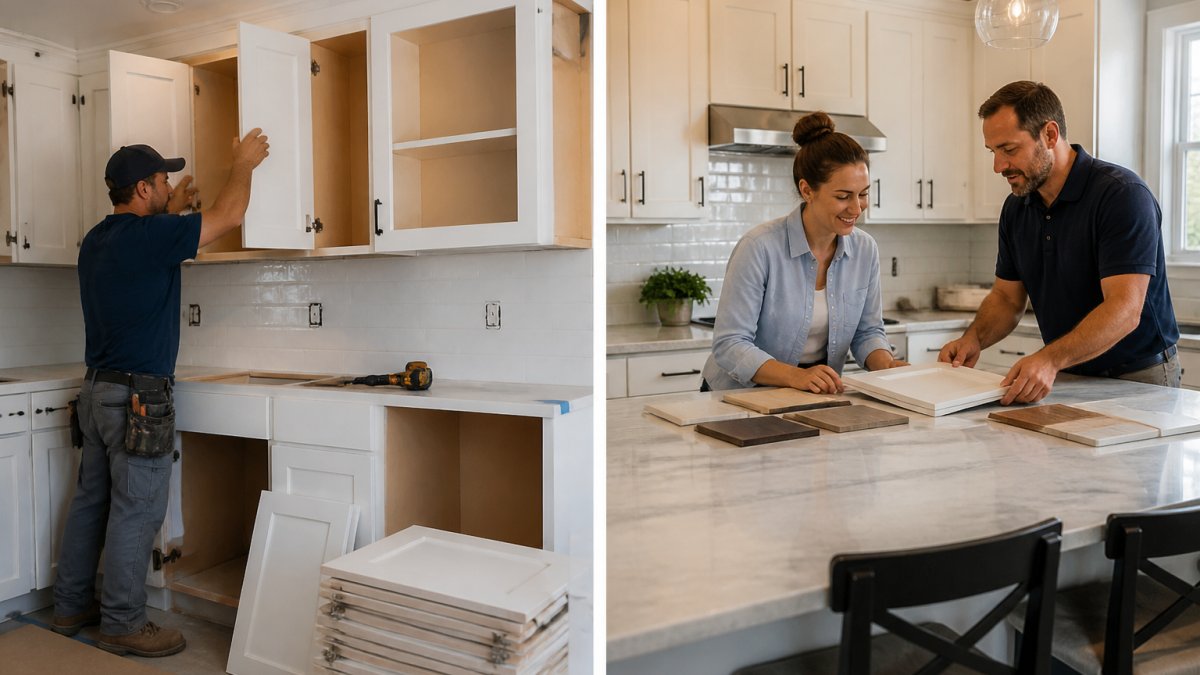
Here is the honest split:
| Factor | Refacing | Replacement |
|---|---|---|
| Typical cost range | Roughly one-third to one-half the cost of replacement for a comparable door style | Highest material and labor line in a kitchen project |
| Timeline | Days, not weeks | Weeks, plus lead time |
| Disruption | Kitchen stays usable | Kitchen offline during install |
| Best for | Sound boxes, dated doors | Worn boxes, layout changes |
| Storage gains | None | Full interior redesign |
| Warranty exposure | Finish and door warranty only; boxes are yours | Full cabinet warranty from manufacturer and installer |
Refacing wins when the boxes are solid and the layout works. Replacement wins when you need different storage, a new layout, or the boxes themselves are failing.
What actually drives the price
Cabinet cost is not one number. It is the sum of box construction, door style and material, interior fittings, and installation labor. A few patterns hold across most projects:
- Door material and profile move the price more than box size. A painted shaker door and a stained raised-panel door can differ substantially even in the same footprint.
- Interior fittings, pull-out shelves, dividers, soft-close hardware, add cost per cabinet, not per project, so a large kitchen feels the increase faster.
- Layout changes are the hidden multiplier. Moving a sink or range means plumbing and electrical work, which can push a replacement project well beyond a like-for-like swap.
- Lead time is a cost in disguise. Custom cabinetry can take weeks longer than semi-custom, and that delay extends any temporary kitchen arrangement.
A simple decision rule
Use this sequence before you request quotes:
- Check the boxes. Open a cabinet and press on the back panel. If it flexes or the shelf pins are crumbling, refacing will not save you, and replacement is the honest answer.
- Check the layout. If you are keeping the footprint, refacing is viable. If you want an island, a different work triangle, or more storage, replacement or a partial renovation is the realistic path.
- Check the finish condition. Paint and veneer adhere best to sound, clean surfaces. Peeling or water-damaged frames usually mean replacement.
- Check the budget ceiling. If refacing plus new countertops and hardware still leaves room, that combination often delivers more visible change per dollar than replacement alone.
Ask each provider to quote refacing and replacement for the same door style and hardware package. Comparing unlike scopes is the most common reason homeowners misjudge which option is actually cheaper.
For a mid-range kitchen, refacing typically lands in the low five figures when paired with new countertops and hardware, while full replacement commonly runs higher and can climb quickly once layout changes are involved. Get both numbers in writing before you decide.
Partial Kitchen Renovation Ideas for Older Homes
Older homes rarely need a full gut renovation. They need targeted fixes. A partial kitchen renovation addresses the failing parts and leaves the sound structure alone.
The usual candidates:
- Countertops and backsplash where the surface is chipped or dated
- Flooring where the subfloor is level but the finish is worn
- A kitchen island addition if the footprint allows, without moving walls
- Fixture and lighting swaps to modernize function
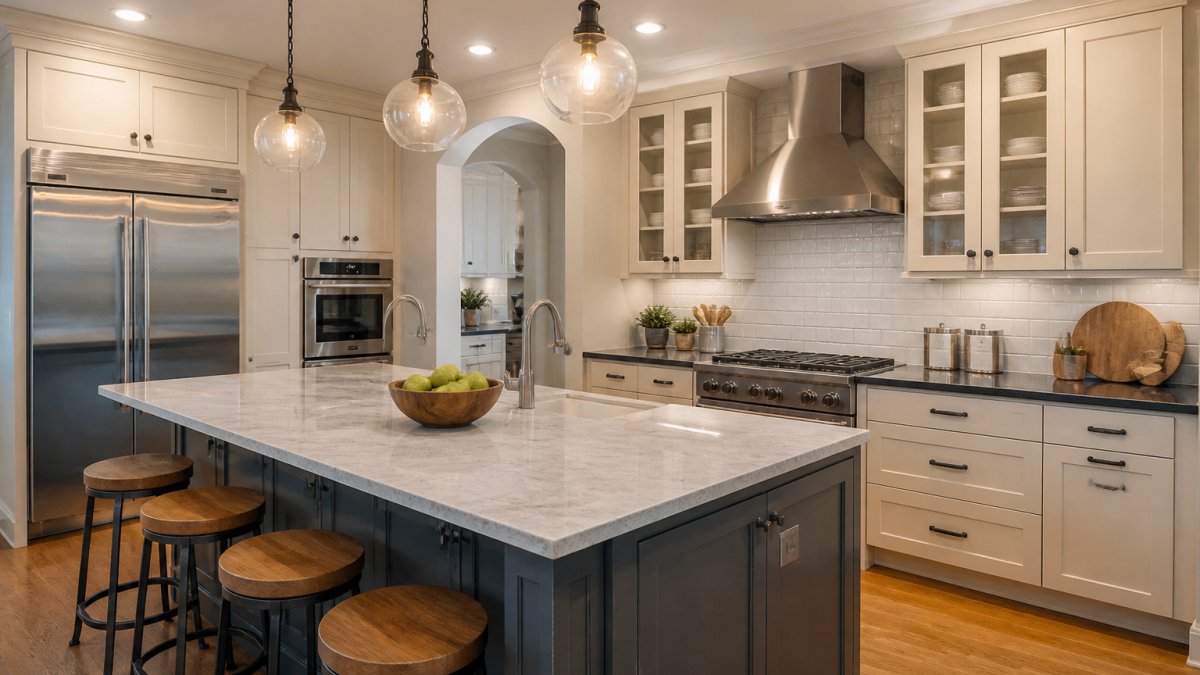
This is where 3D rendering earns its keep. Seeing the proposed island or countertop in your actual room, before demolition, prevents the expensive mistake of building something that does not fit the space or your daily routine.
For homeowners weighing a $40,000 to $60,000 mid-range scope, partial renovation usually delivers more finished value than stretching the same budget across a full remodel.
How to Compare Remodeling Providers Before You Commit
Most homeowners compare contractors on price alone. That is the wrong first filter. Compare on process, proof, and communication, and if you are evaluating a specific provider as an alternative, compare on the criteria that actually predict whether the project finishes on time and on budget.
Use this framework to score each provider you consider:
1. Service area and project fit
Confirm the provider actually works in your area and routinely handles the scope you need. A company that excels at full gut remodels may not be set up for refacing or partial updates, and vice versa. Ask how many projects of your type they completed in the last year.
2. Design support
Ask whether design is included or billed separately, whether you get 3D renderings before demolition, and who owns the design decisions. A provider that plans every cut in advance reduces the chance of mid-project surprises.
3. Installation model
Find out whether the company uses its own crews or subcontractors, who supervises the work, and how structural surprises are handled. The answer tells you how much control the provider has over schedule and quality.
4. Warranty and contract terms
Get the warranty in writing, including what it covers and for how long. The FTC’s guidance on home improvement contracts is worth reading before you sign. It covers the contract terms and cancellation rights that protect you.
5. Reviews and documented outcomes
Look for reviews that describe the process, not just the finished kitchen. Ask to see a before-and-after of a project similar to yours, and ask what went wrong on it. A provider who cannot describe a single problem is either new or not being straight with you.
6. Communication and payment schedule
Confirm who communicates with you and how often, and get the payment schedule in writing, tied to milestones rather than calendar dates.
Use this checklist before signing anything:
- Ask for a written scope that names every line item, not a lump sum
- Request proof of how they handle structural surprises mid-project
- Confirm who communicates with you and how often
- Ask to see a before-and-after of a project similar to yours
- Verify how they protect your home during construction
- Get the payment schedule in writing, tied to milestones
A provider who cannot explain their process in plain language is telling you something. Listen to it.
Timelines, Disruption, and Staying in Your Home During Construction
The biggest hidden cost of a kitchen remodel is not materials. It is disruption.
This is where the approach matters. The U.S. Department of Energy’s guidance on home renovations notes that planning the sequence of work up front reduces both cost and downtime.
Realistic expectations:
- Refacing and paint: days of active work, minimal disruption
- Partial renovation: one to two weeks of focused work
- Full remodel: weeks of disruption, often with the kitchen offline
Ask any provider to walk you through the day-by-day sequence before you commit. A firm timeline is a sign of a firm process.
Conclusion
The real challenge with any kitchen renovation is not picking a style. It is choosing a scope you can afford, live through, and trust your contractor to deliver. A smaller, well-planned alternative often beats a full remodel on both value and stress.
At Remodeling Pros, we built our process around that reality. Our Last Day Breakthrough system keeps your structure intact until the final moment, our 3D rendering lets you see the finished kitchen before we build it, and our surgical demolition keeps your family at home during construction.
Get a quote from Remodeling Pros and start with a plan you can actually see.
Frequently Asked Questions
What are the best alternatives to a full kitchen renovation?
The strongest alternatives to a full gut renovation are cabinet refacing, cabinet painting, hardware and fixture swaps, countertop replacement, and partial layout changes. Each keeps part of your existing kitchen intact, which cuts both material and labor costs. Cabinet refacing replaces doors and drawer fronts while reusing the cabinet boxes. Painting refinishes the existing faces instead of replacing them. Swapping hardware, lighting, and faucets is the lowest-cost option. A partial renovation that keeps the layout but updates surfaces sits between these and a full remodel. The right pick depends on cabinet condition, layout problems, and how long you plan to stay.
How can I update my kitchen without replacing the cabinets?
You can change how cabinets look and function without tearing them out. Painting or refinishing the existing doors and boxes is the cheapest route. Refacing swaps the doors, drawer fronts, and veneer while keeping the boxes, which gives a near-new look at a fraction of replacement cost. Add new hardware, soft-close hinges, and under-cabinet lighting for a bigger visual jump. Interior organizers, pull-out shelves, and drawer dividers improve storage without touching the exterior. If the boxes are solid and the layout works, these updates deliver a strong visual refresh for far less than cabinet replacement.
Is it cheaper to reface kitchen cabinets or replace them?
Refacing is almost always cheaper than replacement because you keep the existing cabinet boxes, which are the most expensive part to build and install. Refacing covers doors, drawer fronts, and exposed box surfaces with new material and typically takes far less time, so labor costs drop too. Replacement makes sense when the boxes are warped, water-damaged, or the layout needs to change. If your boxes are solid and the layout works, refacing gives you a new look without the cost and disruption of a full tear-out. Get an itemized quote for both so you can compare labor and material side by side.
Can you remodel a kitchen without a full gut renovation?
Yes. A partial renovation keeps the layout, plumbing, and electrical where they are and updates the surfaces and fixtures instead. Common partial projects include new countertops, a backsplash, refaced or painted cabinets, updated lighting, and a fresh coat of durable paint. Because you avoid moving walls and rerouting utilities, permits and timelines shrink, and you can often stay in the home during the work. The catch is that hidden issues, like old wiring or water damage, can surface once surfaces come off. A contractor who inspects before quoting will tell you whether a partial scope is realistic for your kitchen.